How Do Lisfranc Injuries Occur? Oxnard & Northridge
Injuries to the Lisfranc joint most commonly occur in automobile accident victims, military personnel, runners, horseback riders, football players and participants of other contact sports, or something as simple as missing a step on a staircase. Lisfranc injuries occur as a result of direct or indirect forces to the foot. A direct force often involves something heavy falling on the foot. Indirect force commonly involves twisting the foot.
Types of Lisfranc Injuries
There are three types of Lisfranc injuries, which sometimes occur together:
- Sprains. The Lisfranc ligament and other ligaments on the bottom of the midfoot are stronger than those on the top of the midfoot. Therefore, when they are weakened through a sprain (a stretching of the ligament), patients experience instability of the joint in the middle of the foot.
- Fractures. A break in a bone in the Lisfranc joint can be either an avulsion fracture (a small piece of bone is pulled off) or a breakthrough the bone or bones of the midfoot.
- Dislocations. The bones of the Lisfranc joint may be forced from their normal positions.
Symptoms:
The symptoms of a Lisfranc injury may include:
- Swelling of the foot
- Pain throughout the midfoot when standing or when pressure is applied
- Inability to bear weight (in severe injuries)
- Bruising or blistering on the arch are important signs of a Lisfranc injury. Bruising may also occur on the top of the foot.
- Abnormal widening of the foot.
Diagnosis:
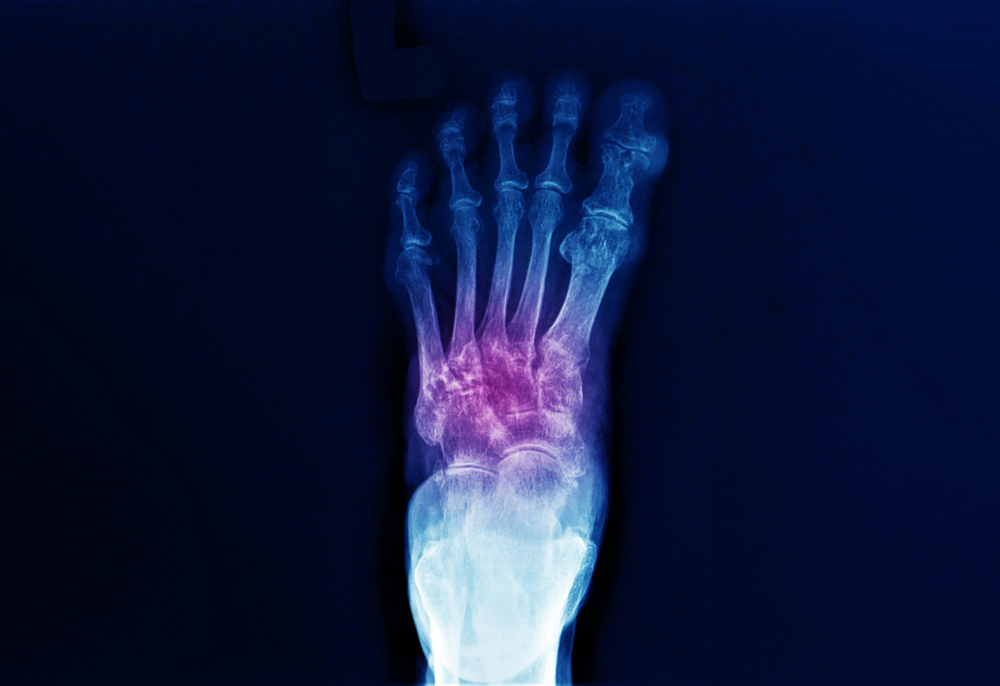
Lisfranc injuries are sometimes mistaken for ankle sprains, making the diagnostic process very important. To arrive at a diagnosis, the foot and ankle surgeon will ask questions about how the injury occurred and will examine the foot to determine the severity of the injury. X-rays and other imaging studies may be necessary to fully evaluate the extent of the injury. The surgeon may also perform an additional examination while the patient is under anesthesia to further evaluate a fracture or weakening of the joint and surrounding bones.
Non-surgical Treatment:
Anyone who has symptoms of a Lisfranc injury should see a foot and ankle surgeon right away. If unable to do so immediately, it is important to stay off the injured foot, keep it elevated (at or slightly above hip level), and apply a bag of ice wrapped in a thin towel to the area every 20 minutes of each waking hour. These steps will help keep the swelling and pain under control. Treatment by the foot and ankle surgeon may include one or more of the following, depending on the type and severity of the Lisfranc injury:
- Immobilization. Sometimes the foot is placed in a cast to keep it immobile, and crutches are used to avoid putting weight on the injured foot.
- Oral medications. Nonsteroidal anti-inflammatory medications (NSAIDs), such as ibuprofen, help reduce the pain and inflammation.
- Ice and elevation. Swelling is reduced by icing the affected area and keeping the foot elevated, as described above.
- Physical therapy. After the swelling and pain have subsided, physical therapy may be prescribed.